


 English
 русский
 Español
 عربى
 日本語

 Home / News / Industry News / What Are Miniature Ball Bearings Used For? Core Uses and Selection Guide
What Are Miniature Ball Bearings Used For? Core Uses and Selection Guide
 2026.10.30
 Industry News
Content
- 1 Miniature Ball Bearings at a Glance
- 2 The Most Common Uses of Miniature Ball Bearings
- 3 Dental and Medical Equipment
- 4 Robotics, Automation, and Precision Instruments
- 5 Small Motors, Fans, and Everyday Equipment
- 6 Bearing Designs and Where Each One Shines
- 7 Matching Bearing Materials to the Working Environment
- 8 Key Specifications to Define Before You Order
- 9 How to Choose a Reliable Miniature Bearing Manufacturing Partner
- 10 A Practical Selection Workflow
Miniature Ball Bearings at a Glance
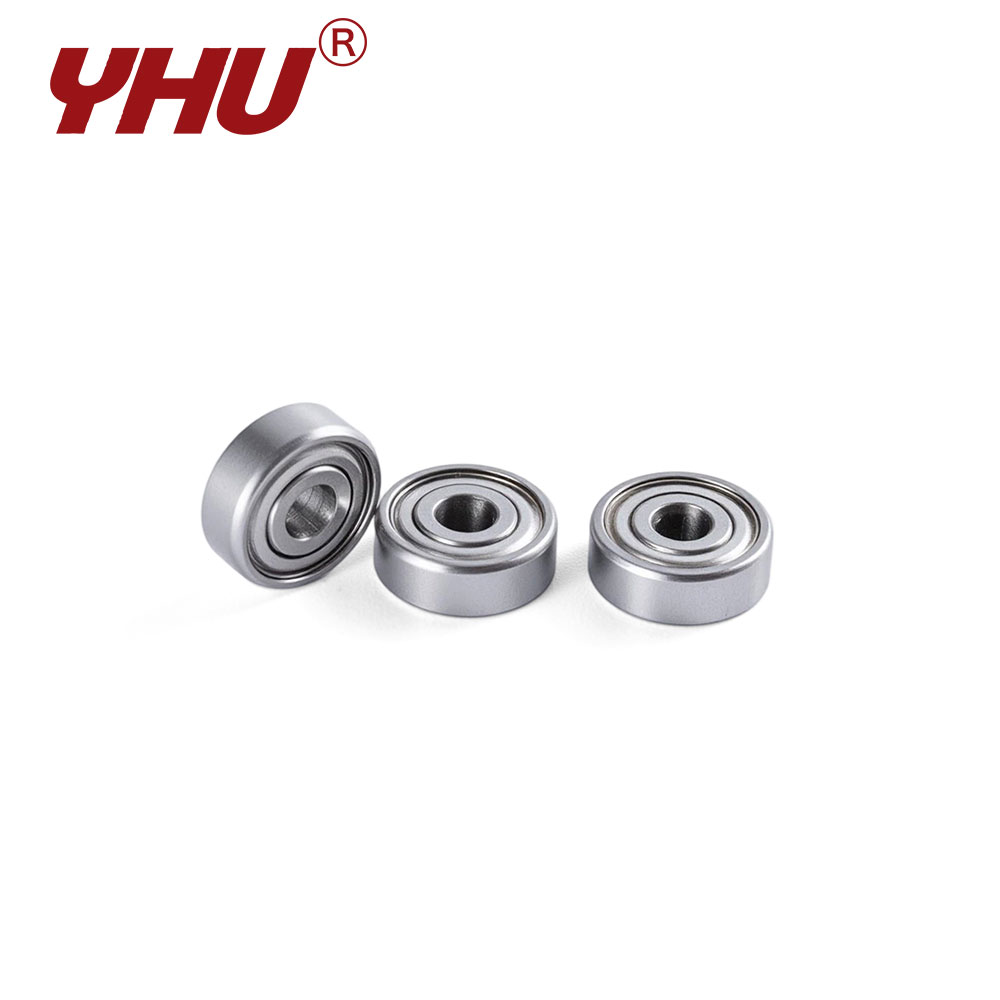
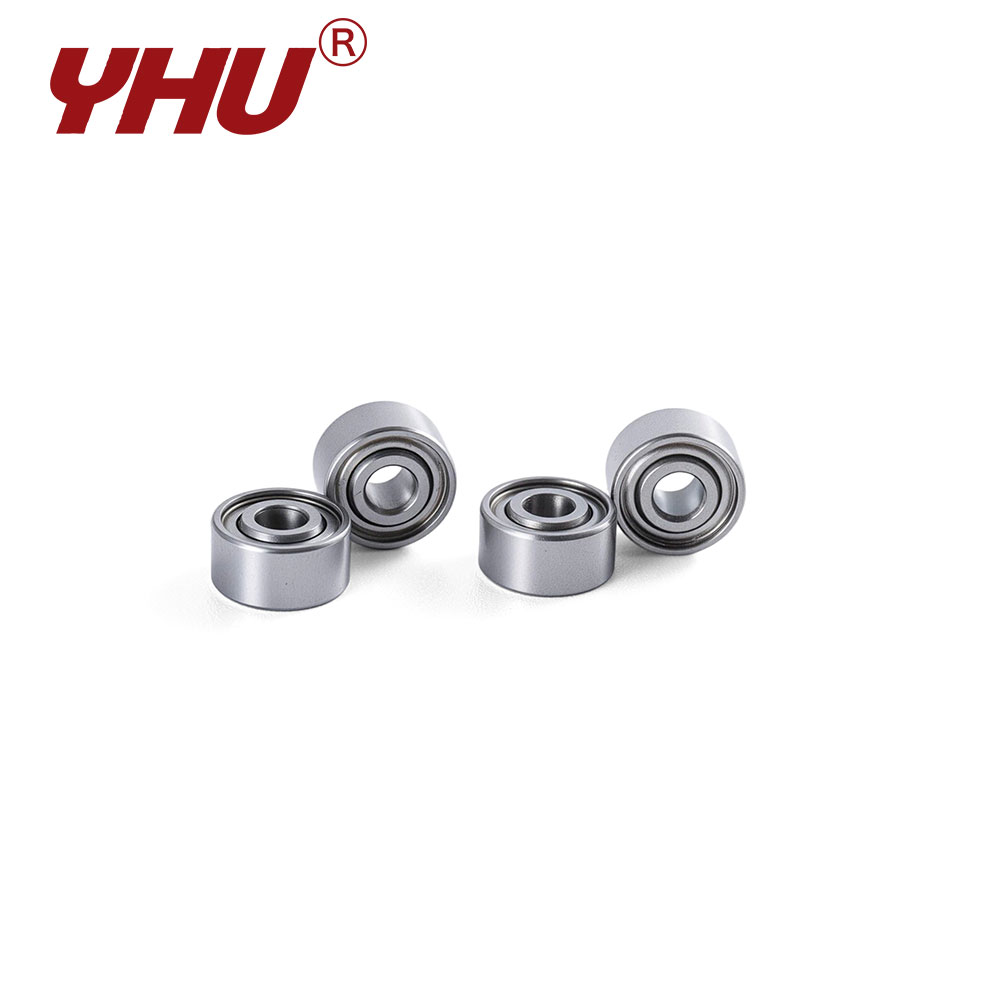
A miniature ball bearing is a rolling-element bearing with an outside diameter of 26 mm or less, and bore sizes that can go as low as 1 mm. Despite its small package, it works exactly like a full-size ball bearing: hardened raceways support precision balls, and a cage keeps those balls evenly spaced. The real difference is manufacturing precision. A bearing small enough to sit on a fingertip can carry a meaningful load, reach extreme speeds, and run quietly for years when designed and built correctly.
The size family covers inch series such as R133, R2, R6, and R8, alongside metric series like MR10, MR11, MR12, and the 60, 68, and 69 families. Beyond standard radial types, miniature bearings also come as flanged versions such as the FR and MF series, plus angular contact, thrust, thin-section, and thin-wall designs. Every configuration exists to solve a specific mounting or loading problem.
Materials matter as much as geometry. Chrome bearing steel is the default for most miniature bearing applications. Stainless steels such as SUS304, SUS316, SUS420, and SUS440 add corrosion resistance for humid or sterilized environments. Zirconia and silicon nitride ceramics handle aggressive chemicals, provide electrical insulation, and tolerate very high speeds. Engineering plastics like POM, PEEK, PTFE, and PVDF serve applications where weight, chemical compatibility, or quiet running matters more than extreme stiffness.
Because miniature bearings are hidden inside so many familiar products, the question of what they are used for deserves a close look. The short answer is that they are used wherever space is limited but rotation still needs to be smooth, precise, and reliable.
The Most Common Uses of Miniature Ball Bearings
Miniature ball bearings appear in an exceptionally wide range of equipment. The main categories are captured below, and the following sections explain the specific demands of each environment.
Dental and Medical
High-speed dental handpieces, low-speed dental tools, grinding machines, surgical instruments, and medical pumps rely on tiny bearings that run cleanly after repeated sterilization.
Robotics and Automation
Servo motors, encoder spindles, robot joints, and precision linear actuators need compact bearings with consistent low resistance and high positional accuracy.
Instrumentation and Measurement
Optical encoders, flow meters, anemometers, shaft position sensors, and laboratory devices require bearings with minimal friction and low torque ripple.
Small Motors and Fans
Coreless DC motors, brushless motors, stepper motors, cooling fans, and micro generators all carry miniature bearings as their primary rotating support.
Consumer Electronics
Hard disks, camera gimbals, video stabilizers, printer rollers, scanner mechanisms, and electric shavers use very small bearings to keep parts turning smoothly.
Aerospace and Specialty
Flight actuators, satellite positioning mechanisms, fuel metering devices, and other specialty systems use ceramic or hybrid miniature bearings where non-magnetic and high-speed properties matter.
The pattern across all these categories is consistent: the bearing is often one of the smallest components in the product, yet it decides how long the product keeps working. Under-sizing a bearing or choosing the wrong material tends to shorten bearing life and, in turn, the life of the entire device.
| Application Area | Typical Bearing Design | Main Requirement |
|---|---|---|
| Dental high-speed handpiece | Angular contact or deep groove | Ultra-high speed, corrosion resistance |
| Robotic joint | Deep groove or angular contact | Accuracy, low friction |
| Flow meter | Deep groove | Low resistance, low noise |
| Cooling fan | Flanged deep groove | Simple mounting, quiet run |
| Camera gimbal | Thin-section deep groove | Compact axial space |
| Miniature thrust application | Thrust ball | Axial load support |
Dental and Medical Equipment
Among the most demanding uses of miniature ball bearings is the dental handpiece. A high-speed dental drill can spin beyond 300,000 rpm, and the bearing pair inside must hold the spindle precisely centered while surviving repeated sterilization cycles. Steam, heat, and chemical disinfectants attack ordinary steel quickly, which is why dental bearings are usually made from stainless steels, or from ceramics in the most demanding designs. Our high-speed dental drill bearings are built for this exact balance: the extreme rotational speed needed for efficient cutting, combined with the corrosion resistance required to endure harsh cleaning.
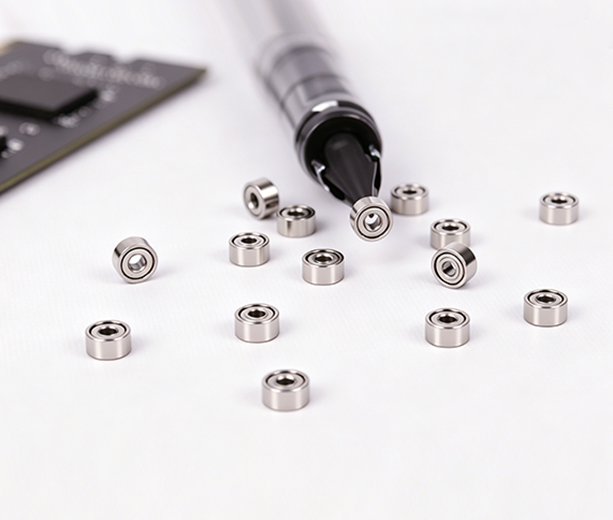 Dental Handpiece Bearings for High- and Low-Speed DrillsThis category covers bearings for high-speed drills up to 400,000 rpm and low-speed handpieces, balancing rotation speed, corrosion resistance, and quiet operation for dental use.View Product →
Low-speed dental handpieces ask for different behavior. They run at lower speeds but see higher torque, and they must stay quiet because they operate directly beside the patient. The bearing inside a low-speed handpiece, and in the related grinding and polishing machines, has to handle repetitive side loads and tolerate whatever lubricant the device protocol permits.
Another factor specific to medical equipment is cleanability. The bearing geometry should not create crevices that trap biological material or cleaning agents. Open bearings in these devices are uncommon; shielded or sealed versions, with a lubricant that can withstand disinfection, are preferred. This is one of those details that does not appear on a catalog page but makes the difference between a prototype and a product that passes regulatory scrutiny.
Beyond the dental chair, miniature bearings are found in surgical drills, bone saws, infusion pumps, peristaltic pumps, and dental scalers. The common thread is hygiene. These applications favor all-stainless construction, or at least stainless raceways with ceramic balls, because corrosion and contamination are not acceptable. When selecting a bearing for a medical device, engineers should think about the sterilization method first. Autoclave temperature and chemical exposure will decide whether SUS440C stainless, another stainless grade, or a full ceramic design is the right answer.
Robotics, Automation, and Precision Instruments
Robotic systems place unusual demands on miniature bearings. A robot arm is effectively a chain of rotating joints, and each joint needs a bearing that supports the mass of the links beyond it while still allowing precise, repeatable movement. In compact robots used for assembly, inspection, and laboratory automation, that job often falls to a miniature deep groove or angular contact bearing with tight radial runout.
Encoders and resolvers deserve special attention. These sensors translate rotation into position signals, and any wobble inside the bearing becomes a direct source of measurement error. A bearing with an uneven raceway creates periodic signal noise in the position data. This is why encoder designers specify bearings with tightly controlled radial runout and smooth ball-to-race contact.
The same principle extends to precision instruments. Flow meters use miniature bearings to support turbine-style impellers, where friction drag directly affects calibration and repeatability. Anemometers, gas sampling instruments, optical measurement tools, telescope mounts, laser leveling systems, and surveying devices all rely on bearings that start moving smoothly and never stick.
In a flow meter, for example, the impeller bearing experiences a nearly constant load at a roughly constant speed. Over time, viscosity changes in the measured fluid, vibration from nearby machinery, and temperature drift all work against the bearing. A small increase in bearing resistance changes the meter reading by a noticeable amount, which is why certified calibration procedures depend on repeatable bearing behavior.
Miniature bearings also give instrument designers valuable flexibility. If an off-the-shelf size is close but not perfect, a small modification in material, cage, or lubrication can adapt the bearing without changing the envelope. This is where working directly with a manufacturer that handles nonstandard and custom shaped bearings adds real value to a project.
Small Motors, Fans, and Everyday Equipment
If one place can be called the home of the miniature ball bearing, it is the small electric motor. Coreless DC motors, brushless micro motors, stepper motors, and gear motors all need a bearing on the rotor shaft. These motors power drones, medical pumps, electric toothbrushes, automotive mirror actuators, electronic throttles, and HVAC dampers, so the miniature bearing industry moves enormous volumes into motor assembly lines.
Cooling fans and blowers are another high-volume user. A fan bearing must run quietly for thousands of hours, carry the radial weight of the fan blade, and tolerate the temperature rise of the motor. Flanged miniature bearings are especially popular in fan manufacturing because the flange presses into a stamped housing, eliminating the need for a separate shoulder or snap ring and speeding up assembly.
Consumer devices add their own constraints. Camera gimbals need bearings that rotate freely so a stabilization motor can counter gravity smoothly. Printers need quiet, consistent roller bearings so the paper path stays accurate. Hard disk spindles use precision miniature bearings because any wear debris can threaten the recording surface. In every case, the bearing is chosen for low noise, low torque, and consistent quality.
Replacement maintenance is another angle. In many small appliances and automotive actuators, a miniature bearing is the first component to age because it rotates nearly every time the device runs. Offering a recognized series number with published dimensions makes the aftermarket path easier for service teams and end users.
Textile machinery, packaging equipment, and small conveyor rollers also rely on miniature bearings. These roles are less visible but just as important: the bearing supports a light load, keeps the roller turning freely, and never squeaks or heats up. The selection logic is always the same: match the material to the environment, the size to the envelope, and the lubrication to the duty cycle.
Bearing Designs and Where Each One Shines
Miniature bearings are built in several design families. The designs look similar from the outside, yet the differences matter significantly in practice. Understanding these differences is the fastest route to selecting the right bearing for a product.
Deep Groove Ball Bearings
The deep groove design is the default choice for most miniature applications. It handles radial loads well, carries moderate axial loads in both directions, runs at high speeds, and remains quiet. Metric MR series and inch R series belong to this family, along with thin-section versions. A deep groove miniature bearing suits electric motors, instruments, rollers, and nearly any application without exceptional loading conditions.
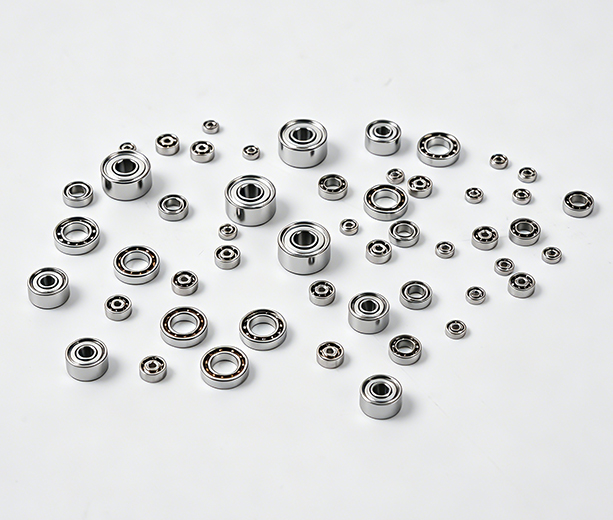 Deep Groove Miniature Ball Bearings in Steel and StainlessThese versatile bearings handle radial and moderate axial loads at high speeds. Available in bearing steel or stainless, they suit motors, instruments, and compact assemblies.View Product →
Flanged Bearings
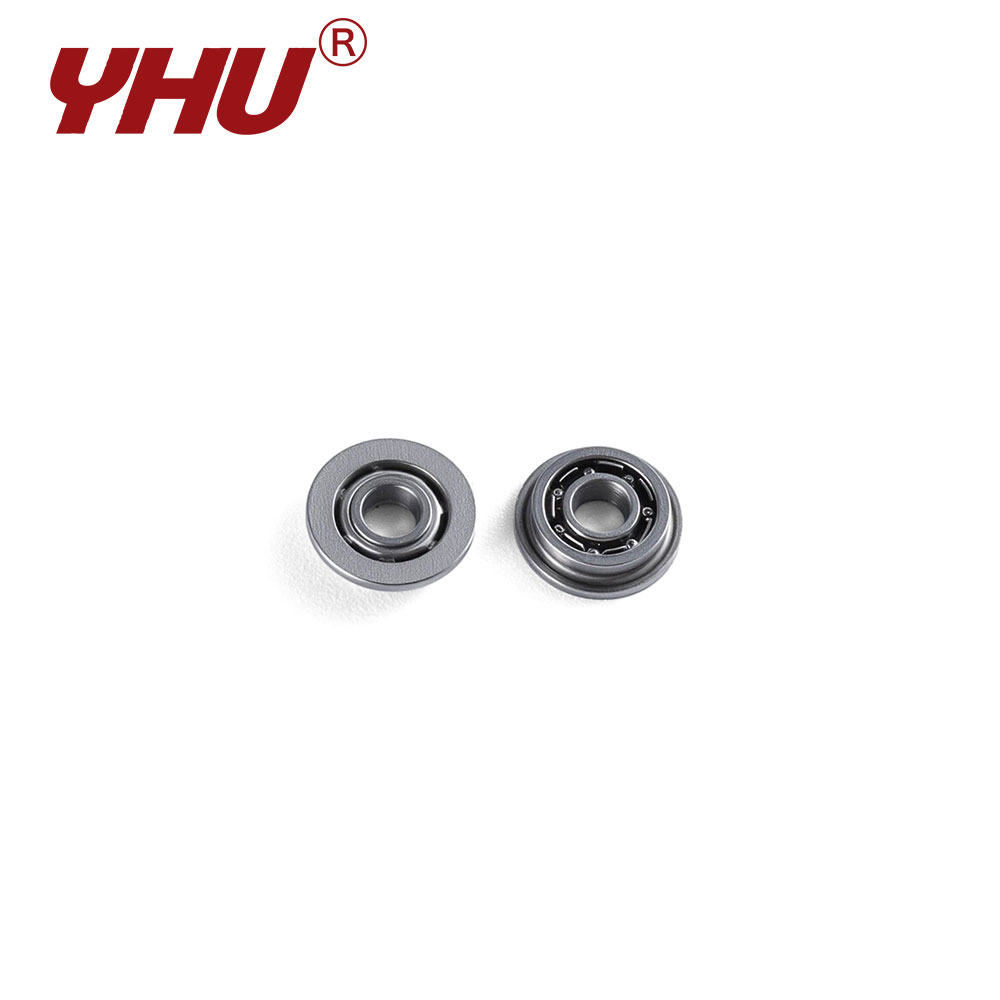
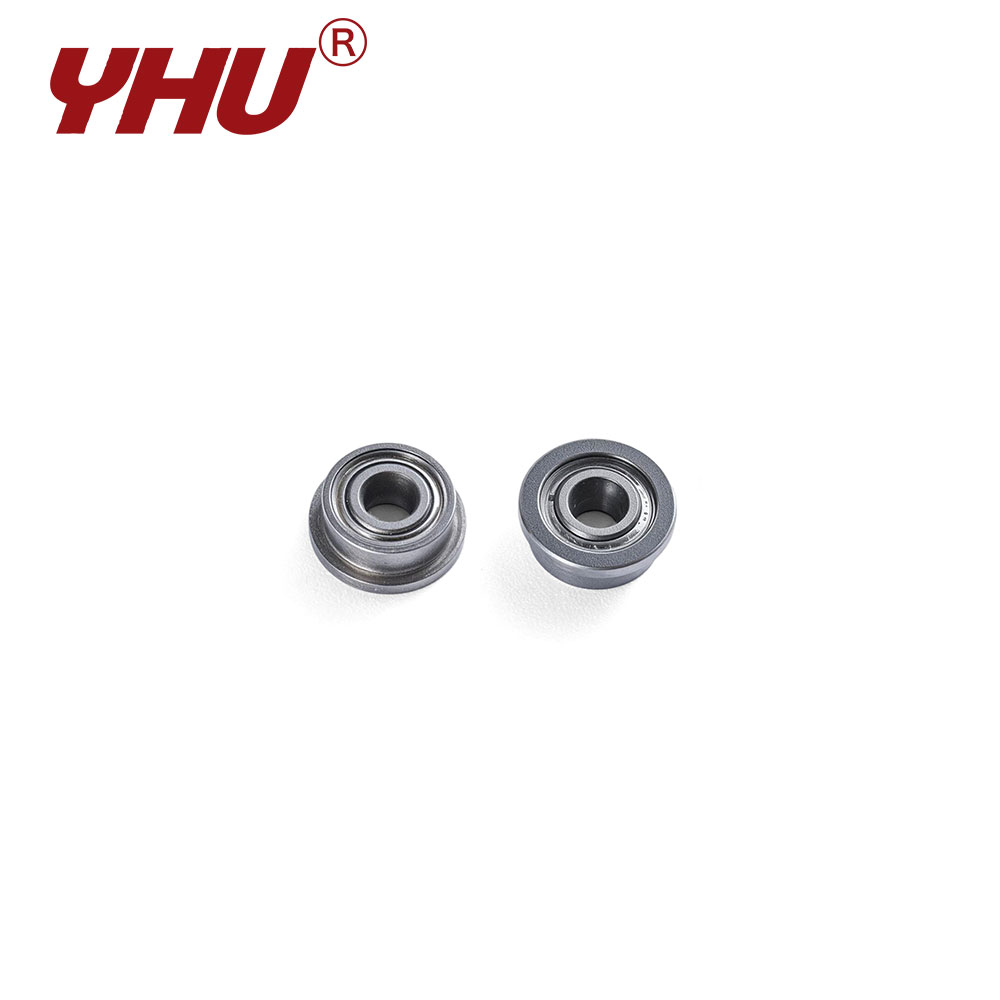
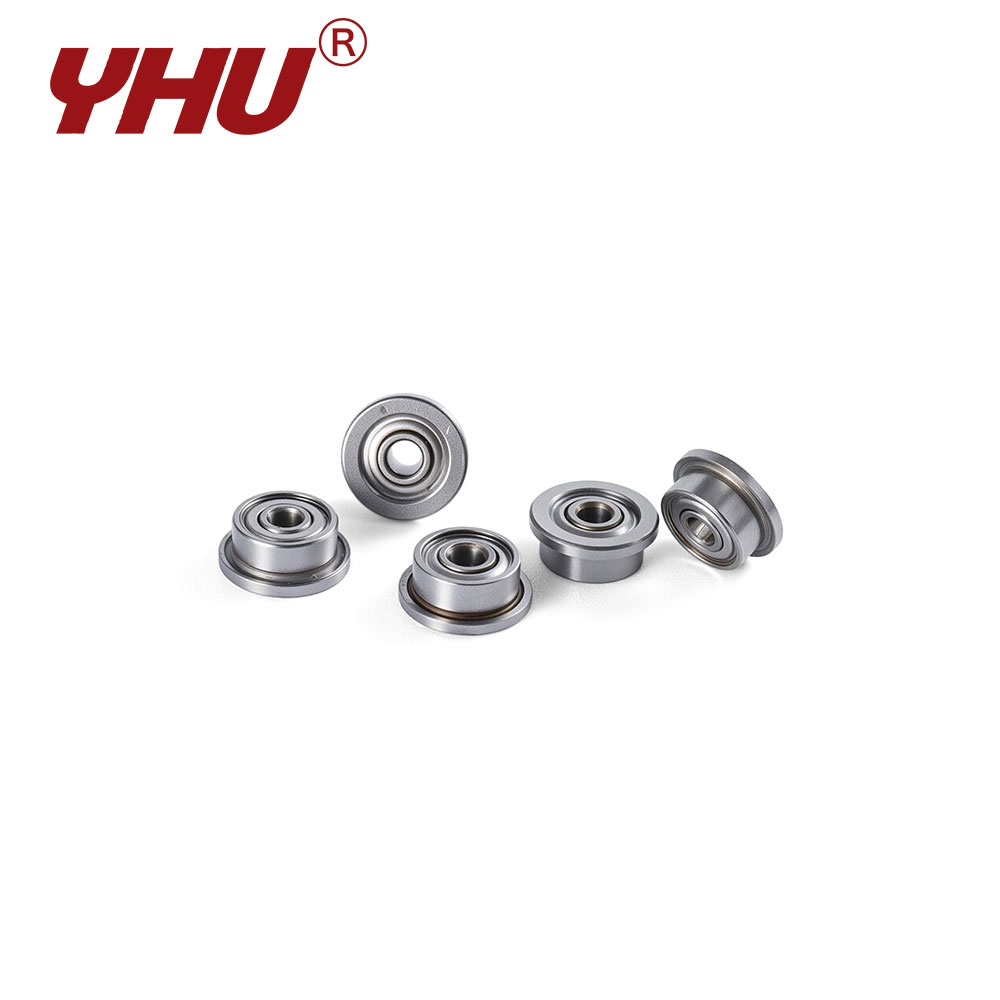
A flanged bearing integrates a thin flange into the outer ring, which acts as a locating shoulder. The bearing can be pressed into a simple through-bore without a separate retaining device. Flanged miniature bearings dominate fan manufacturing, small gearboxes, and other compact assemblies where assembly speed and axial space are valuable. If this design is new to you, our guide on what a flange bearing is and how to install it walks through the mounting process in detail.
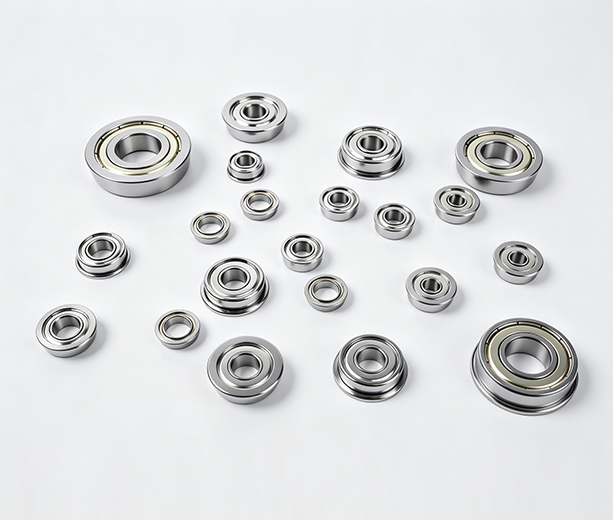 Flanged Bearings with Integral Locating ShoulderFlanged miniature bearings simplify mounting in through-bores, providing axial location without extra parts. Ideal for fans, gearboxes, and compact assemblies requiring fast assembly.View Product →
Angular Contact Bearings
Angular contact miniature bearings manage combined radial and axial loads more effectively than deep groove bearings. They are often supplied in matched pairs for high-speed spindles such as dental handpieces, where the spindle must remain centered under cutting pressure and preload forces.
Thrust Ball Bearings
Miniature thrust ball bearings support pure axial loads. They suit pivots, lead screws, worm gears, and small turntables. A thrust bearing does not handle radial load, so radial support must be provided separately elsewhere in the mechanism.
Thin-Section and Thin-Wall Bearings
When axial space is tight, thin-section (67, 68, 69) and thin-wall flanged series maintain the bore and outside diameter while reducing the width. These designs appear in gimbals, optical mechanisms, and other compact devices where every tenth of a millimeter counts.
Relative Radial Load Capacity by Miniature Bearing Design
| Design | Radial Load | Axial Load | Speed | Typical Use |
|---|---|---|---|---|
| Deep groove | Excellent | Moderate | Very high | Motors, instruments, rollers |
| Flanged | Excellent | Moderate | Very high | Fans, gearboxes, compact assemblies |
| Angular contact | Good | Good | High | Dental handpieces, spindles |
| Thin-section | Reduced | Moderate | High | Gimbals, optics, thin housings |
| Thrust | Not applicable | Excellent | Medium | Lead screws, pivots, axial supports |
Matching Bearing Materials to the Working Environment
The material of the rings and balls is the single largest factor in how long a miniature bearing survives a given application. No material wins everywhere. The correct choice depends on the environment, speed, load, and expected life. Four questions usually decide it: will the bearing see moisture? Will it be sterilized? Is non-magnetic or non-conductive behavior required? What is the operating temperature range?
Chrome Bearing Steel
Chrome steel such as AISI 52100 offers high hardness, excellent wear resistance, and the most favorable cost. It is the natural first choice for dry indoor environments with proper lubrication. If a miniature bearing runs inside a motor that never sees water, chemicals, or sterilization, chrome steel is likely all the application needs.
Stainless Steel Grades
When moisture or cleaning agents enter the picture, stainless steel becomes necessary. SUS440C provides high hardness and good corrosion resistance, which makes it the most common stainless bearing steel. SUS420 balances hardness and corrosion protection for many industrial products. SUS316 and SUS304 provide stronger corrosion resistance but lower hardness, so they suit light-duty applications where rust resistance is the main concern. The exact grade should match the chemistry of the environment: salt spray, steam, detergents, and solvents each stress a bearing differently.
Ceramic Bearings
Full ceramic miniature bearings made of zirconia or silicon nitride deliver properties that steel cannot match. They are electrically insulating, non-magnetic, and highly resistant to chemicals. Zirconia provides excellent toughness, while silicon nitride offers lower density and the highest speed capability. Hybrid designs with steel rings and ceramic balls combine the stiffness of a steel ring with the low friction and electrical insulation of ceramic balls at the contact point.
Plastic Bearings
Plastic bearings are lightweight, corrosion-proof, and quiet, and they can run without lubrication in light-load duty. POM, PA66, PP, and UPE cover general industrial uses. PTFE and PVDF add chemical resistance for aggressive media. PEEK and PI handle higher temperatures. Plastic is a legitimate engineering solution when the load is modest and the environment is difficult.
Hybrid ceramic bearings deserve a special note. They are frequently chosen for dental, medical, and precision spindle applications because the ceramic balls weigh less, create less heat at the ball-to-race contact, and extend the effective operating life at very high speeds. When corrosion resistance is also needed, stainless steel rings can be paired with ceramic balls, covering both speed and hygiene requirements at the same time.
Typical Maximum Operating Temperature by Bearing Material
| Material | Corrosion Resistance | Max Temperature | Speed Capability | Typical Environment |
|---|---|---|---|---|
| Chrome steel | Poor | 120°C | Very high | Dry indoor, oil-lubricated |
| SUS440 stainless | Good | 180°C | High | Humid, mild chemicals |
| SUS316 stainless | Excellent | 200°C | Medium | Coastal, food, clean steam |
| Zirconia ceramic | Excellent | 400°C | High | Chemical, non-magnetic |
| Silicon nitride ceramic | Excellent | 800°C | Very high | High speed, insulating |
| PEEK plastic | Excellent | 250°C | Low to medium | Chemicals, lightweight |
Key Specifications to Define Before You Order
Once the application and material are clear, the next step is writing a complete bearing specification. Incomplete specifications are the most common source of delay in custom miniature bearing supply. The parameters below should always be part of the request.
Dimensional Envelope
The bore diameter, outside diameter, and width define the bearing envelope. In miniature bearings, exact decimal dimensions matter more than nominal sizes, particularly when a housing is thin. If an existing bearing fits the design, sending its reference number allows the manufacturer to identify the series quickly.
Precision Grade
Runout and tolerance requirements determine the precision grade. High-speed spindles and encoders need tight tolerances. Fans and light mechanisms work well with standard commercial grades. Specifying a finer grade than necessary adds cost and lead time without adding value.
Seals and Shields
Open bearings allow the lowest friction and are intended for oil lubrication. Metal shields keep large particles out without contacting the balls. Rubber seals provide stronger protection against fine dust and moisture but add torque. In dental and medical devices, sealed stainless bearings are common because contamination control is essential.
Lubrication
Miniature bearings can be supplied with grease, oil, or a dry lubricant. Grease is the most common choice, and its viscosity, temperature range, and resistance to steam or chemicals determine whether the bearing survives the application. Low-temperature grease keeps drone motors spinning in cold air; high-temperature grease keeps automotive auxiliaries operating after a hot soak.
Internal Clearance
Internal clearance is the play between balls and raceways. It affects how the bearing runs under load and temperature changes. Standard clearance is usually C0 or CN. Interference fits on the shaft or in the housing reduce the available clearance, so the correct preload or clearance value must be chosen in advance.
| Parameter | What to Specify | Example |
|---|---|---|
| Bore x OD x Width | Exact dimensions in millimeters or inches | 3 x 8 x 3 mm |
| Material | Steel grade, ceramic, or plastic | SUS440 stainless |
| Shielding | Open, shield, or seal | Rubber seal |
| Lubricant | Type and temperature range | High-temp grease, -40 to 160°C |
| Radial clearance | Standard code or micron range | C0 standard |
| Precision grade | ABEC or ISO class | ABEC-5 |
| Speed | Maximum operating rpm | 80,000 rpm |
| Load | Radial and axial load values | 1.5 N radial |
How to Choose a Reliable Miniature Bearing Manufacturing Partner
The specification is only half of a successful sourcing project. The other half is the manufacturer's ability to deliver that specification consistently across production batches. As a bearing manufacturer ourselves, we believe the most telling signs are the questions a supplier asks. Does the supplier ask about working conditions or only about quantity? Does the supplier recommend a material because of the environment, or simply quote what was requested? A partner who understands speed, temperature, and contamination will solve problems before they appear.
Look for a factory that controls the whole process. Ring grinding, raceway finishing, ball quality, washing, and lubrication are all steps where quality can be added or lost. A dedicated manufacturer will discuss tolerances on a drawing rather than promising a generic standard bearing. When the application calls for a nonstandard size or a customized design, the factory's ability to adjust material, seals, or cage style matters greatly.
Lead time and batch size also matter. Miniature bearing production involves multiple grinding and finishing stages, so a shorter lead time usually means the manufacturer keeps raw material stock. It is reasonable to ask about stock levels for standard series and about production lead time for custom parts.
Communication is equally important. For a precision component inside a complex assembly, clear dialogue with the factory determines how quickly issues are solved. A manufacturer that asks for the right details at the inquiry stage and answers technical questions without hesitation is worth more than one that responds quickly but behaves like a quote-only desk.
That is also why we openly discuss limitations. Every bearing has a load limit, a speed limit, and a temperature limit. A supplier who instantly says yes to every requirement is usually not checking the physics. An honest conversation about speed, heat, and load during the inquiry stage prevents disappointment in the field and usually results in a longer-lived component.
When a project reaches the ordering stage, a clear specification table makes everything faster and more accurate. Whether the order is a one-time prototype or a regular production run, the same discipline applies: define the environment, choose the material, verify the dimensions, and confirm the lubrication before the first sample is made.
A Practical Selection Workflow
The fastest route to the right miniature ball bearing is to follow a sequence. Engineers who skip steps usually discover the problem later, during prototyping or field testing, when changes become expensive. The workflow below reflects how we approach new miniature bearing requests with customers.
- Define the motion. Identify the rotation speed, whether the motion is continuous or intermittent, and how the shaft is mounted in the mechanism.
- Calculate the loads. Estimate radial and axial loads, including weight, vibration, and assembly preload. A rough estimate is enough to narrow the bearing design choices.
- Measure the envelope. Confirm the bore size, outside diameter, and width allowed by the housing. Add the available axial space if a flange is being considered.
- Assess the environment. Note the temperature range, humidity, chemicals, washing cycles, and any need for non-magnetic or electrically insulating parts.
- Choose the material. Select steel, stainless steel, ceramic, or plastic based on the environment first and cost second. The cheapest material fails fastest in the wrong environment.
- Choose the design. Decide between deep groove, flanged, angular contact, thrust, or thin-section based on the load direction and the mounting method.
- Specify precision, sealing, and lubrication. Define the precision grade, select open, shielded, or sealed construction, and set the lubricant type and temperature range.
- Confirm with the manufacturer. Send the complete specification to the bearing factory for review before sampling. A good manufacturer will flag potential issues and suggest adjustments.
This sequence works for a simple cooling fan and for a complex medical device alike. Once the specification is complete, sampling and validation begin. A well-built miniature bearing shows its value at that point: it runs smoothly, stays quiet, and outlasts expectations in the product it serves.
For engineers narrowing down their options, our full range of miniature deep groove, flanged, thrust, angular contact, ceramic, plastic, and custom nonstandard bearings is a practical place to start the comparison around your specific envelope, load, and environment.
Message Feedback

Professional Manufacturer of Precision Bearings
- Contact Information
-
-
+86 162 6918 9999 +86 136 1619 2555

-
+86 153 0641 4247

-
jeffrey@yhu1988.com

rose@yhu1988.com -
Yinghong Industrial Park, Zexin Avenue, Xingou Auto Parts Industrial Park, Funing County, Yancheng City, Jiangsu Province, China

-
- QR Code
Copyright ©
Jiangsu Yinghong Transmission Technology Co., Ltd.
All Rights Reserved.
Custom Miniature Ball Bearing Manufacturers

